- The Distilled Download
- Posts
- 🧬 The Distilled Download - April 24
🧬 The Distilled Download - April 24
🍹Secret Cocktail Ingredient, 💪 Are isometrics worth it?, 🤖How To Tell a Human, and... Ibogaine?

Avisha NessAiver
April 24, 2026
In partnership with

Greetings, fellow science nerds! 🤓 Here’s your latest installment of The Distilled Download.
It's been a while–because I'm bad at writing emails–but my backlog of cool things I want to share with you guys is pretty insane. As always, rather than just provide you with random tidbits that you read and forget, my goal is to give you:
Something to share and make you sound cool around the dinner table
Something to ponder
Something to do/practice/update your behavior
Something to use (practical gadgets, apps, appliances, etc.)
Something to make you hopeful/excited (most often: cool new science)
Let me know what you like/dislike so I can keep this something you enjoy reading!
I also have a final, super-easy ask for you at the end.
And now.
The Download
🍸 The Flavor They Don’t Expect
When I was a junior in college and started drinking alcohol, I pretty immediately decided that if I was going to drink the stuff, it should at least taste good. I started having people over as guinea pi- I mean guests to try my cocktails before going out. I began making my own infusions, syrups, bitters, etc., in my typical “nerding out” sort of way. I've always said that, in another life, I was probably an alchemist. These days, I often apply the same principles to crafting non-alcoholic drinks, a.k.a mocktails, because why shouldn't we have drinks that both taste good and don't give you hangovers? But while you can make a good drink using just juice, carbonation, sour, and sweet, what really takes a drink to the next level are the aromatics and secondary flavors. If you've ever tasted a bottled mojito versus the real thing made with fresh mint, you know what I'm talking about. Yet, the challenge with fresh herbs is that they go bad, so I'm always on the lookout for things that don't expire that can add a Cool Factor to my drinks that gets my friends puzzling over what that extra flavor is that makes it taste so good.
Enter: Bitters.
A few shakes of these Black Walnut Bitters on top of some apple cider = instant gourmet flavor. I also often add them to orange or pineapple juice to create some interesting depth. My go-to drink during the week is 1-2oz of a juice, 16-20oz of club soda (I use a SodaSense which can carbonate non-water beverages like juice… or wine), a few drops of stevia, and a few shakes of the bitters. It tastes better than soda (to me at least) and has almost no calories/sugar. And for those who don’t like the stevia taste, I find that the little bit of natural sugar from the juice really helps to hide any weirdness.
If you try it, let me know how it goes!
🦾 Training Tip I’m Holding Onto
Most workouts are built around moving weights up and down, but isometric training is the weird little cousin where your muscles work hard without visibly moving. Think planks, wall sits, holding the bottom of a squat, or pushing a barbell into immovable safety pins. The practical takeaway from this Stronger By Science deep dive is that isometrics aren’t magic, but they’re also not the dusty gym relic people sometimes treat them as. They can help build strength, add muscle stimulus, train painful or weak positions more precisely, and target sticking points in lifts. The catch is that they’re specific. If you train a hold at one joint angle, that’s where you’ll get the biggest benefit. So the smartest use is probably not replacing normal full-range lifting, but sprinkling them in where you need extra work: deep split-squat holds for quads, stretched push-up holds for chest, calf holds at the bottom, or brief max-effort pushes against pins for a stubborn bench, squat, or deadlift position. For the full “how much, how hard, and where to put them” breakdown, read the full Stronger By Science article.
I’ve been incorporating them into my workouts for years because I have Joint Hypermobility and I am constantly getting injured in my connective tissue, so isometrics are often a way I can still train even around said injuries.
If you want to see a full article/video series on the topic, let me know!
🙌 Quick Ask From You
Click this link 👇 (below) to give me $1!
I decided to accept a sponsor for this week’s newsletter, which is another newsletter about AI that I’ve been reading for over a year now. I specifically look for it in my inbox each morning, and it’s one of the ways I stay up to date with the latest AI news and tools. I think you’ll enjoy it, but if all you do is click that link, then it helps me be marginally less poor 🙂. I put the ad itself at the bottom of the email so as to not disrupt the flow, but check it out!
Moving on:
🤨🤖 I Promise I’m Not A Robot?
But how can you tell?
As the Internet gets flooded with AI-generated content and new image and video models are coming out every day (ChatGPT’s new Images 2.0 model is insane- it just overtook Gemini’s NanoBanana), it's becoming harder and harder to easily identify real from fake just by looking at it. I've talked about this before, but very soon the internet is going to have to move from a "real until proven fake" model towards a "fake until proven real" one. We’ve discussed how the C2PA partnership between Adobe, Google, Meta, OpenAI, and many more companies is working on developing a system to prove that images and video came from a real camera via a form of cryptographic chain of custody (imagine a secret password being embedded by the camera in the image), but now the new World ID system is aiming to do the same for Human Verification.
The idea is that you verify once in person using one of World’s Orb devices, which takes images of your eyes and face, creates a unique code from them, sends that “personal custody” package to your device, then deletes the images from the Orb. After that, your phone can use cryptographic proofs to show apps that you are a verified human without handing over your name, email, or identity. The practical goal is very “post-AI internet”: dating apps can badge real people (they’re already partnering with Tinder), concerts can reserve tickets for humans instead of bots, Zoom and Docusign can verify that a real person is present, and AI agents can prove there’s a human behind them.
You can visit an Orb Near You for free.
🌿 We’re In for a Strange Trip
I began my week thinking that I’d finish editing a video I filmed to kick off my Optimalism series–stay tuned for that–but I immediately got derailed by reading the latest psychedelic developments. If you haven’t heard, Trump just signed an executive order aimed at speeding up the scientific and regulatory processes that are necessary in order to get psychadelics like psilocybin, LSD, and Ibogaine into widespread use for treating conditions ranging from depression, PTSD and anxiety to helping with substance use disorder for nicotine, alcohol, and, especially, Opiates. I normally hate covering anything to do with politics, but this is a development that genuinely excites me.
Many anti-Trump folks are condemning this whole Order, pointing to the fact that it originated with a text from Joe Rogan and highlighting how ibogaine has a lot of cardiotoxicity worries that this will bypass. But iff you read the Order itself, there's no bypassing happening here–just a directive to increase scientific research, match funding, and remove regulatory red tape to speed up the approval process without making it any less rigorous. I did one video covering what the order actually says, and another pointing out how Joe Rogan got his facts completely wrong while speaking in the oval office (who’s surprised?).
I also spent a while doing a complete literature review about the safety and efficacy of Ibogaine (coming soon), and overall I’m hopeful. The results are mostly from low-quality evidence sources, but it definitely seems to have a lot of potential for treating PTSD and opiate addiction. The cardiotoxicity aspects can be greatly mitigated by pre-screening, monitoring, and possibly the co-administration of the right electrolytes like magnesium.
Thanks for reading! I love to hear feedback, so feel free to respond to this email or tag me on Twitter or Threads (which I’ll start using seriously one of these days 🙊).
The AI Work Handbook That Cuts Your Workday in Half
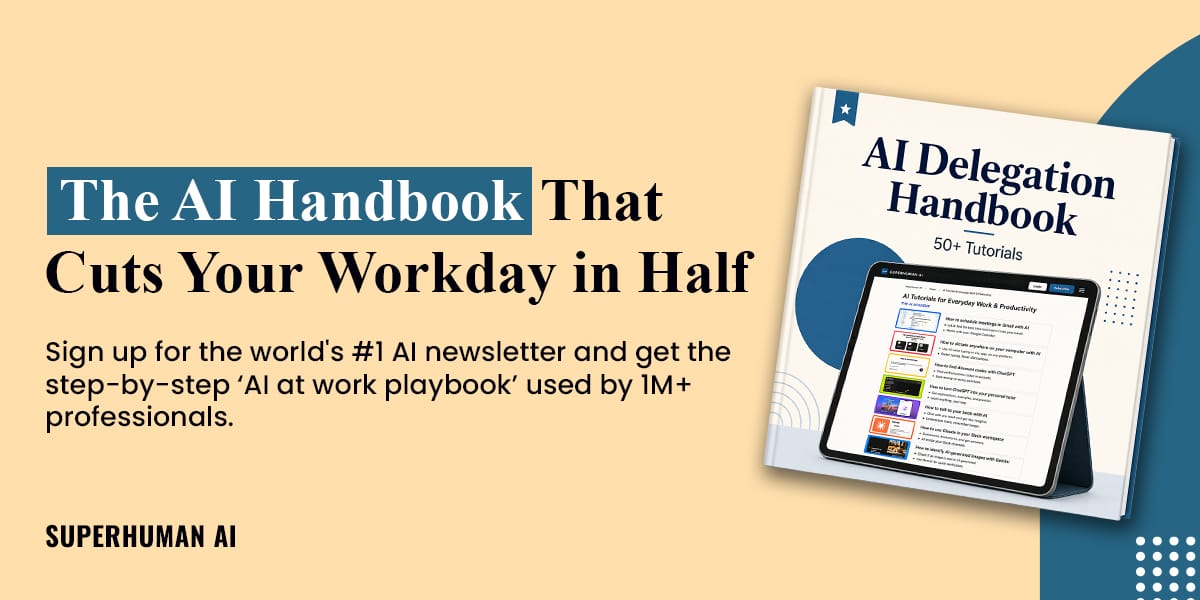
The 8-hour workday is becoming a 4-hour workday for people who know how to use AI.
Everyone else is still catching up.
This AI work playbook shows you exactly how to cut your work hours in half using AI.
Sign up for Superhuman AI and get:
50+ step-by-step AI tutorials to cut your workload in half — covering every part of your workday, from emails to strategy, used by 1M+ professionals at Google, Microsoft, and NASA
Superhuman AI newsletter (4 min daily) so you keep discovering new AI tools and skills to stay ahead in your career — the playbook is just the start
Reply